Our Featured Presentation: Snow White and the Seven Dwarfs
A breakthrough in cinema, and the film that legitimized the animated feature

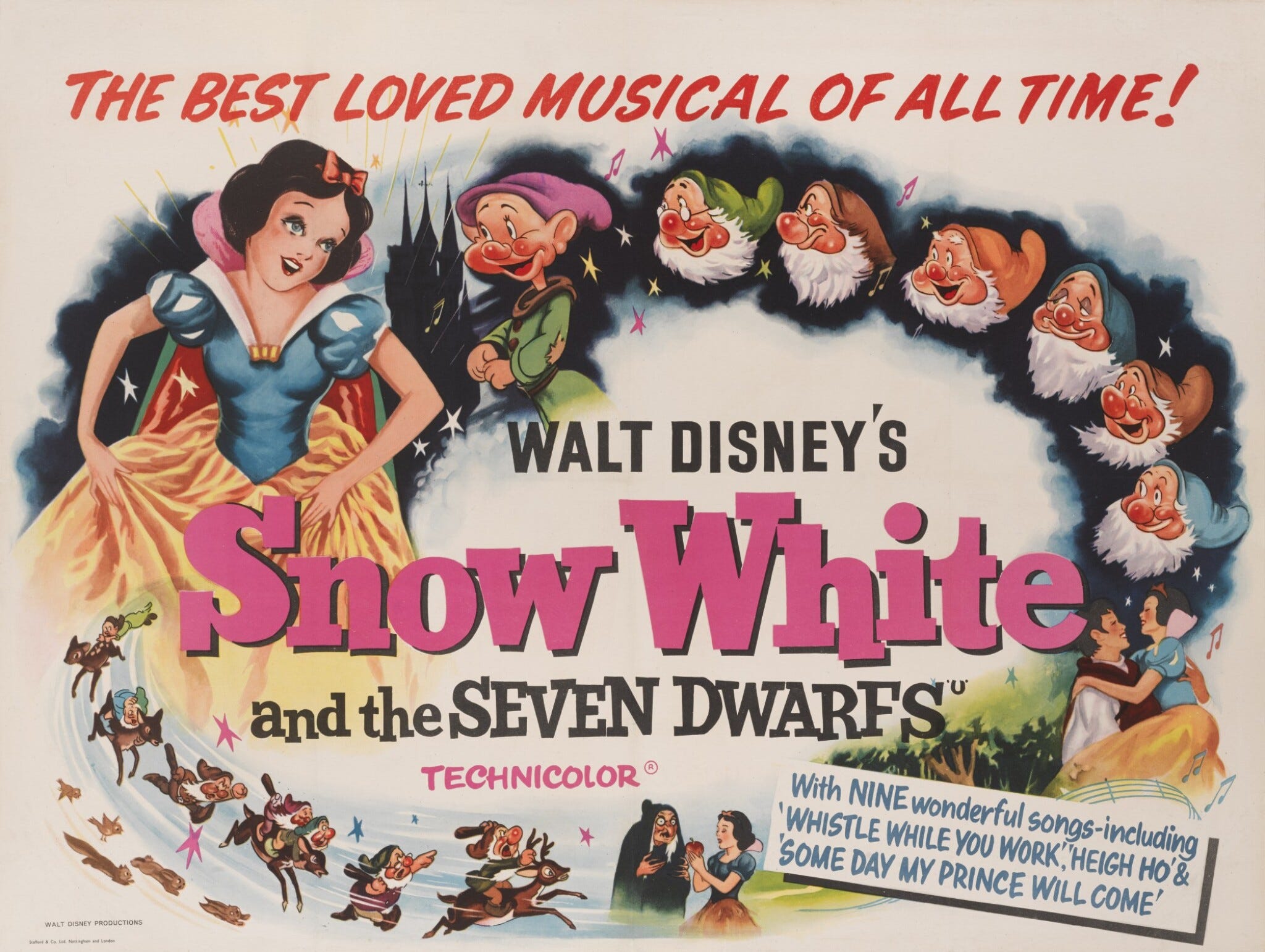
Synopsis: A cruel queen is envious of her stepdaughter and sends her into the forest to be murdered. However, the assassin cannot do the deed, and the young princess flees to exile, only to find sanctuary and friendship from seven dwarves, dwelling deep in the woods.
I: Once Upon a Time …

Sometimes a trip to the cinema shapes your whole life, an industry, maybe even the whole world.
According to Walt Disney himself, the first step on his path to making Snow White and the Seven Dwarfs came in 1916 when he was a newsboy in Kansas City. There was a special screening of J. Searle Dawley’s Snow White, starring Marguerite Clark in the lead role. Clark had performed the part on Broadway for two years, and even though she was in her thirties when the film was made, her petite stature and youthful looks meant she still could play the ingenue. And there she was, on screen as the fairytale heroine in what one can only imagine was a rowdy and rapt audience, including the teenage Walter Elias Disney.
Maybe it wasn’t just Clark’s charming performance, or the on-screen magic of witches and dwarves and princes, that quietly influenced Walt. Maybe it was Dawley as well, arguably the first filmmaker to be called a director. Like Clark, his roots were in theatre, and when he was hired by Edwin S. Porter of the Edison Manufacturing Company in 1907 to oversee the now-lost comedy short “The Nine Lives of a Cat” there were no directors. At least, not in the sense that Dawley or modern audiences would understand the word. Camera operators and producers ran the set, and Dawley turned that all upside down. To him, character, performance, continuity and story were everything, and Porter gave him the latitude to put those at the front.
The film was now the director’s work, and the director’s vision was increasingly important. Nowhere was this more obvious than his most daring decision: to release his silent Snow White as an epic six reels, not the normal five. This was too long. Features were five reels but Dawley stuck to his guns, and so his Snow White was six. He then further blew up conventional wisdom when his too-long movie became a smash, so much so that it was shown on four screens the day that Walt saw it.
II: Disney’s Folly
Like Dawley, Walt was breaking new ground, defying logic. The idea of spending nearly $2 million on an animated feature with none of his famous characters like Mickey Mouse or Donald Duck, based on a story everyone had seen or read a dozen times, aimed at kids, and only one year into his new distribution deal with RKO, seemed like madness. No wonder the trades called it “Disney’s folly.” Maybe he should just stick to shorts.
It didn’t help that Walt’s “official” story for starting the product was that, in 1935, he, his brother Roy, and their wives took on a European vacation and he came back with the idea to do Snow White. The reality was that he’d been actively looking to do a feature since 1933.
Walt Disney Studios had been founded in 1923 as Disney Brothers Cartoon Studio, and had limited success until 1928, when Mickey Mouse became a burgeoning icon with the first cartoon with a soundtrack “Steamboat Willie.” But it’s in 1929 when everything really changes, when the studio starts producing the Silly Symphony series: 75 shorts that became smashes, made big money, and earned Walt seven Oscars. But there was a problem. As legendary animator Ward Kimball explained, “We’d run out of funny things to do.”
III: Who’s On First?

For a long time, the common understanding was that Snow White was the first animated feature – but that’s simply not true. The problem is that no one is really sure what is.
It’s likely that Colvig Pinto had an opinion or two on the matter. By 1937 he was one of Disney’s go-to voice actors, voicing mainstays like Goofy, Peg Leg Pete, and Pluto, and Walt brought his flexible vocal cords in for Snow White to play three of the dwarfs: Sleepy, Grumpy, and Dopey. However, Colvig began his career in animation days as a writer, director, and editor. In those roles, he may have made the first animated feature, 1916’s Creation – but that’s completely missing except for five frames, and no one is quite sure how long it was or if it was ever released.
The following year, Argentinian animator Quirino Cristiani released El Apóstol, a satire on the morality crusade of President Hipólito Yrigoyen. That film is at least confirmed as being a feature, its articulated paper animation running to 70 minutes – but it’s now lost media, as the sole copy to exist was lost in a fire on Cristiani’s studio in 1926. Cristiani went on to make a second animated feature in 1918, Sin Dejat Rastros, while six years later Chilean animators Carlos Espejo and Carlos F. Borcosque used the same cutout technique for Vida y milagros de Don Fausto, an unlicensed adaptation of the popular cartoon strip Bringing Up Father.
However, all of these are lost, and the records are scant to say the least. The first extant animated feature arrived in 1926 with Die Abenteuer des Prinzen Achmed (The Adventures of Prince Achmed) by Lotte Reiniger, which used silhouettes to retell elements of Hanna Diyab’s One Thousand and One Nights. However, the technique leads to a long-running argument as to whether it was really animation or actually puppetry.
The next big leap forward comes in 1935 with the release of Russian filmmaker Aleksandr Ptushko take on Gulliver’s Travels entitled Новый Гулливер (The New Gulliver), an innovative mix of live-action and stop motion.
As with Prince Achmed’s silhouettes, that hybrid component may disallow it for consideration by purists, but there’s no such argument about le roman de Renard (The Tale of the Fox), Ladislas Starevich and Irène Starevich’s stop motion version of the classic morality tales of Reynard the Fox. In fact, Renard predates Gulliver by seven years, as the animation was finished in 1930, but cinema being what it is the French film sat on the shelves until finance was available for a soundtrack and it was finally released – first in Germany in 1937, then in France in 1940.
Was Disney ignoring these projects when claims were made about Snow White being the first animated feature? Quite possibly not. The South American films were likely never shown outside of the region and have been lost for years. Achmed was released internationally, even opening in New York, but its flat, puppeteered look was radically different to what Disney was doing, and the same was true for Renard, which was likely not even seen in America when he premiered Snow White.
IV: First of Her Kind
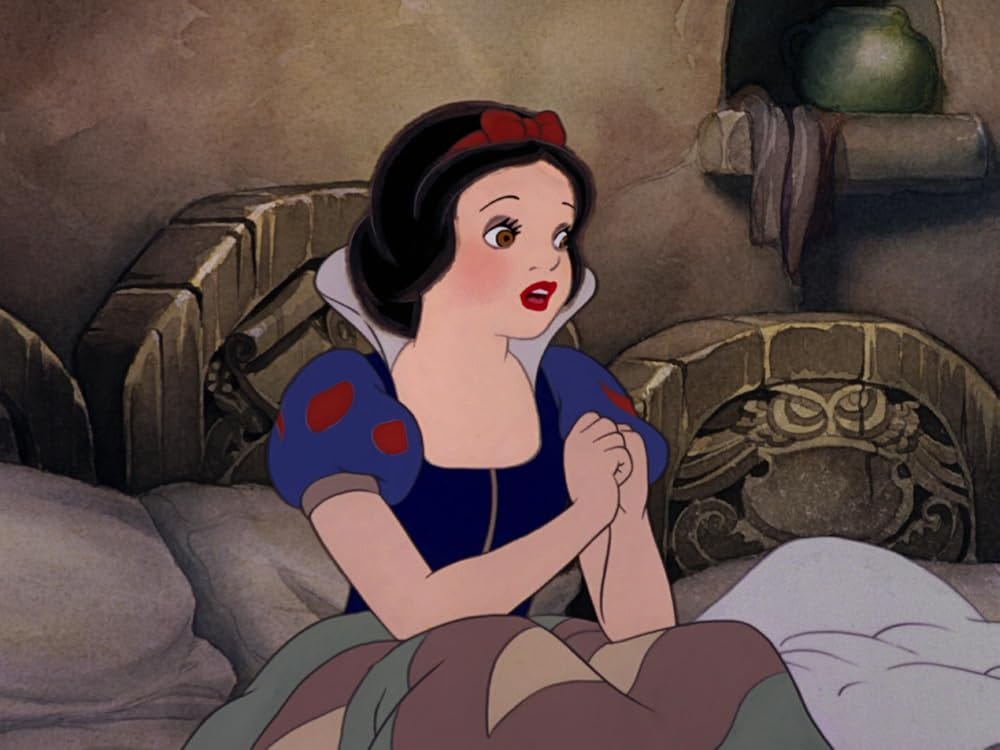
But looking back now, with that historical and international context, how can one describe Snow White as a first? It’s definitely the first American animated feature, the first in English, and the first to see a genuinely wide international releases. It’s also the first cel animated feature, a landmark in that right. There’s also an argument that it’s the first movie to do for musical cinema what the musical Show Boat had done for the American stage, dumping the revue format and making the songs part of the storytelling. Plus, as Professor Sarah Banet-Weisser of the Annenberg School has noted, it’s the first animated feature with a female protagonist. So even if it’s not the first, it achieves many firsts.
Such firsts always create challenges and hurdles, and Walt saw the contradictions of what would be needed to get the film done – that it had to be done with more detail and yet faster.
Early cartoons had been, well, cartoonish, but the goal was to come closer to real life. Disney’s biggest competitor, Max Fleischer, did this through Rotoscoping, literally drawing over live action footage to give a baseline naturalism to the movement. Disney took a different approach, using such footage for reference rather than tracing. One of the first models? Marge Champion, who Disney would employ for the reference footage for the motions of Snow White while voice actress Adriana Caselotti – another regular around the Disney offices – would read her lines and sing her songs.
Disney had also encouraged his artists to take life drawing classes. “Encouraged” is the right word as they’d started them of their own accord. Animator Art Babbitt had been inviting the guys in the office to his home for weekly sessions with a model. Eventually those informal sessions were moved to the studio, and Walt hired fine artist Donald W. Graham to teach his animators how people, animals, material, and nature move.
At the same time, Walt was encouraging them to look beyond individual frames and concentrate on the flow. It was a necessary change in thinking to produce an unprecedented 120,00 frames of animation to create the 83-minute runtime, even if it led to the modern complaint that individual frames can look off or even downright disturbing. But contemporary audiences weren’t watching screengrabs (not that such a thing existed them). They were watching the whole movie, and so Walt wisely realized that they weren’t interested in frames A, B, C, D – they were watching the transition from A to D and would fill in the blanks.
On the story side, Walt may have been inspired by Dawley’s 1916 film, but it is definitely not a note-for-note retelling. In the earlier version, the story is not contained within a book, but delivered by Santa Claus, who enters a home and leaves behind a collection of dolls who come to life and re-enact the fairytale. There’s a whole subplot about the Huntsman (Lionel Braham) and his family, and there is far more court intrigue, including how royal handmaiden Brangomar (Dorothy Cumming) becomes queen and Snow White’s stepmother. Moreover, the evil queen and the witch are separate characters. The dwarves are all basically identical, without the rudimentary name-as-character conceit of the Disney version: all, that is, save for Quee who is the prototype for Dopey in that he’s on the receiving end of all indignities. As for Snow White, Clark played her with a little more guile than the animated innocent has, and there’s much more development of her relationship with the prince before she is sent into exile.
Walt’s version had other inspirations, not least his own work, and there are undoubted thematic connections and resonances to one of his Silly Symphonies, 1932’s Babes in the Wood. A soft retelling of Hansel and Gretel, it has the standards of the story: a brother and sister lost in the woods who are taken in by a seemingly kind old lady with a gingerbread house, only to find she has malicious and magical intentions. But what he added was what can only be seen as an early version of the dwarves. Actually, they’re more gnomes than dwarves, a small army (and, at one point, air force) who come to Hansel and Gretel’s aid, until finally the witch is caught by one of her own spells and turned to stone.
Snow White quickly establishes what will become Disney’s in-house storytelling conventions – not least that there is no fat on the narrative meat. Within the first 10 minutes, the audience has been introduced to Snow White, the Prince, the Huntsman and, of course, the Queen. Even in the title sequence, the story book opens up of its own, magical accord, as if the tale cannot wait to be told. And for audiences expecting an over-extended Silly Symphony, what they got was revolutionary.
As Walt said in a 1956 interview about Snow White, “With every laugh, there must be a tear.”
V: The Woods are Lovely, Dark, and Deep

The tears were pulled forth when Walt hired Grim Natwick to give him the heroine he needed. A former sheet music cover artist, Natwick was seen as the best animator of women working at the time, having made the pivotal design changes to Max Fleischer’s Betty Boop that made her a star and a sex symbol. Walt had tried to hire him in 1931, but Natwick instead went to work for Walt’s sometime collaborator, sometime rival Ub Iwerks. By 1934, word was spreading that Walt was looking to make a feature, and Natwick was eager to work on such a groundbreaking project, so Walt got his wish. He immediately set Natwick to work on a short, The Cookie Carnival (1934) and then Broken Toys (1935) because both of them centered on female protagonists, and he knew that whoever was drawing Snow White had to make her feel like a living, breathing young woman.
But Natwick wasn’t working alone or pulling his images from thin air. One of the biggest innovations of the film is the use of reference footage of Marge Champion, captured by Ham Luske. She’s arguably the first fully-rounded human character ever seen in an animated film. There’s a depth to her, a liveliness that pushed past other animated characters. At the same time, the malice around her draws empathy from the audience, making them truly feel for this lost princess.
That edge of darkness, much of it attributed to the input of supervising art director Albert Hurter and sketch artist Ferdinand Horvat. Take the nightmarish, surrealist sequence as Snow White first flees through the forest, where trees distort, logs become crocodiles, and branches become grabbing hands. Yet Disney knew how much horror to include. We never see the pig’s heart in a box with which the Huntsman dupes the queen, but we know it’s there. Similarly, upon consuming the poisoned apple, Snow White “dies” offscreen, but to a ghoulish narration by the Queen about congealing blood.
It’s clear that the Queen deals with magic, but it’s unclear until after Snow White has endeared herself to the dwarfs that it becomes clear how deeply enmeshed in sorcery she is. Beneath the castle, where she transforms herself into a warty-nosed crone, she dwells in a realm of smoke and spells. The dramatic irony of her pronouncement that she will be fairest just as she transformed herself into a monster is too perfect.
Then there’s her casual inordinate cruelty. As she descends to the river running below the castle to deliver the poisoned apple to Snow White, she sees a skeleton in the dungeons, skinless arms stretched to an empty pitcher. “Thirsty? Have a drink!” she cackles, kicking the jug to dead prisoner, scattering bones, defiling the corpse.
She is a true force for evil, and Sam Raimi understood how devilish she was. In Evil Dead 2, when the dead and possessed Henrietta tries to force her way out through the trap door under the cabin, it’s one of the most famous shots from Snow White – the witch as hag, cackling as she disappears into the dungeon – but shown in reverse.
VI: A Field Guide to Turtles of the Black Forest

Not that there’s no comedy. Walt wanted to expand the dramatic possibilities of animation, but he also knew this was entertainment, and so everyone on the lot was allowed to chip in jokes. If a gag was used, they got five bucks: if it was a humdinger, like how the dwarfs’ noses pop over the end of the bed when they first see Snow White, then they walked home with a cool ten-spot.
After all, Disney knew jokes. The studio was built on three-to-five-minute funnies, and while Snow White was revolutionary, there were still nods to (to quote the old saying) those that brung them to the dance. The subtlest reference may be a cameo appearance of sorts by a character the studio was trying to make a star while Snow White was in production.
When Snow White is guided through the forest by all the little animals, they are mostly simply adorable and surprisingly naturalistic. However, one character stands out: a slow-moving turtle who ambles as everyone else gambols and is responsible for some of the best sight gags in the opening act. He may well have looked familiar to anyone who saw the 1935 short The Tortoise and the Hare, a Silly Symphony based on Aesop’s Fable. The cocksure Max Hare (voiced by Ned Norton) is an irksome figure, half preppy and half roughhousing lady’s man, who has challenged the milquetoast Toby Tortoise (Ned Norton) to a race. Of course, Max’s constant flirting and arrogance sees him lose to the resilient and somewhat oblivious. It’s clear that Disney had high hopes for the duo. As their on-screen adventures were in cinemas, they turned up in homes via the newspaper funny pages as part of the syndicated Silly Symphony strip in the short-lived The Boarding School Mysteries, written by Ted Osborne and illustrated by Al Taliaferro. There was a second short, the boxing-themed Toby Turtle Returns, released in 1936, but bar a few quick cameos and Easter Egg appearances over the decades that’s really the last time they are seen.
It’s hard not to imagine a twinge of recognition and maybe resentment in Walt two years after that second short when Warner Bros released Porky’s Hare Hunt. Part of their Looney Tunes series (the name a not-so-subtle riff on Disney’s own Silly Symphony), it featured a wisecracking rabbit, strikingly similar to Max Hare. Two years later, he would finally get a name: Bugs Bunny.
Even though Max disappeared into cinema history, it’s also hard not to see the turtle that accompanies all the other woodland animals on Snow White’s journey into the woods as a relative of Toby’s. Or, at least, the production team knew that it was easy to make a turtle the butt of some harmless jokes.
VII: Meet the Dwerch
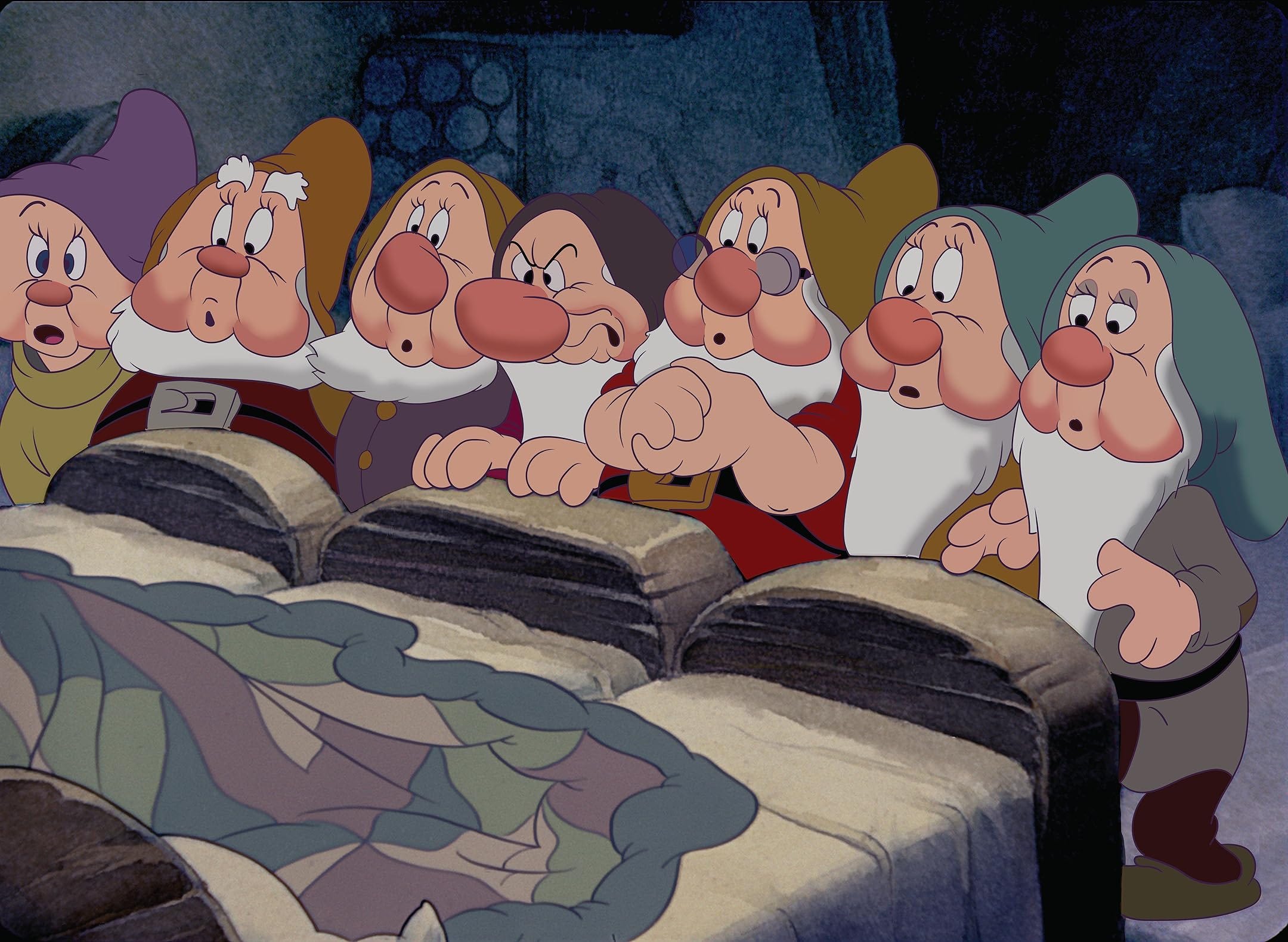
Nowhere is Walt’s mix of comedy and pathos more perfectly combined than in the dwarfs. In Sealey’s live-action version, they’re all basically the same, just short guys in big fake beards. Disney’s dwarfs are distinct. Each is given subtle design differences – a bigger beard here, glasses there, a more bulbous nose – but the bigger differences come from their unique personality quirks, no matter how thin. Sleepy yawns, Happy laughs, Sneezy sneezes, Bashful blushes and tugs on his beard, and they all get their sight gags. However, the core trio are all given more finished individual identities, to facilitate the plot and add extra comedy. Doc isn’t just the leader, but spouts malapropisms to highlight his humility. Dopey is not actually completely silent – he emits a wail as he runs from Snow White as she sleeps in the septet’s bed, then snores as he pantomimes the monster under the sheets to his fiends – but his wordless silliness and near-instant crush on the pretty stranger in their home is absurd and heartwarming. Meanwhile Grumpy is the only one to show doubts about this pesky interloper. Of course, he is the one who weeps the most when she seems lost to them.
They are not small people. The story and the setting makes it clear that these are dwerch, the mystical folk of Low Country and Germany. Exactly which country is unclear, arguably not least because this is a mid-20th-century version of the story, not one constructed by cultural historians. But even though they are recast here as friendly uncles, the dwarfs retain many of the traditional aspects of the dwerch: a love of treasure, a commitment to hard labor, irascibility, and remarkable skills as craftsmen. The pump organ that Grumpy plays as the dwarves sing and dance for Snow White’s pleasure during “The Yodeling Song” features intricately carved animals as the pipes (showing that ideas would gestate in Disney’s brain for decades, it’s hard to not see shades of what would become The Enchanted Tiki Room in those anthropomorphized designs.)
The exact location of the story is blissfully unmoored from specifics but rather filtered through the European aesthetics of Hurter (a fine artist by training) and colorist Gustaf Tenggren, who had cut his teeth as a children’s book illustrator and was profoundly influenced by Arthur Rackham and the Pre-Raphaelites. The woodlands in which the dwarfs dwell are undoubtedly meant to evoke the dark and powerful mythology of the Bavarian Black Forest, but the design of the Queen’s castle is often seen as being influenced by the Alcázar of Segovia, a Medieval Spanish castle northwest of Madrid. Just don’t ask why the very midwestern Toby Turtle is there, or the African vultures that follow the witch, have washed up in this corner of Western Europe.
VII: Is Beauty Really Skin Deep?
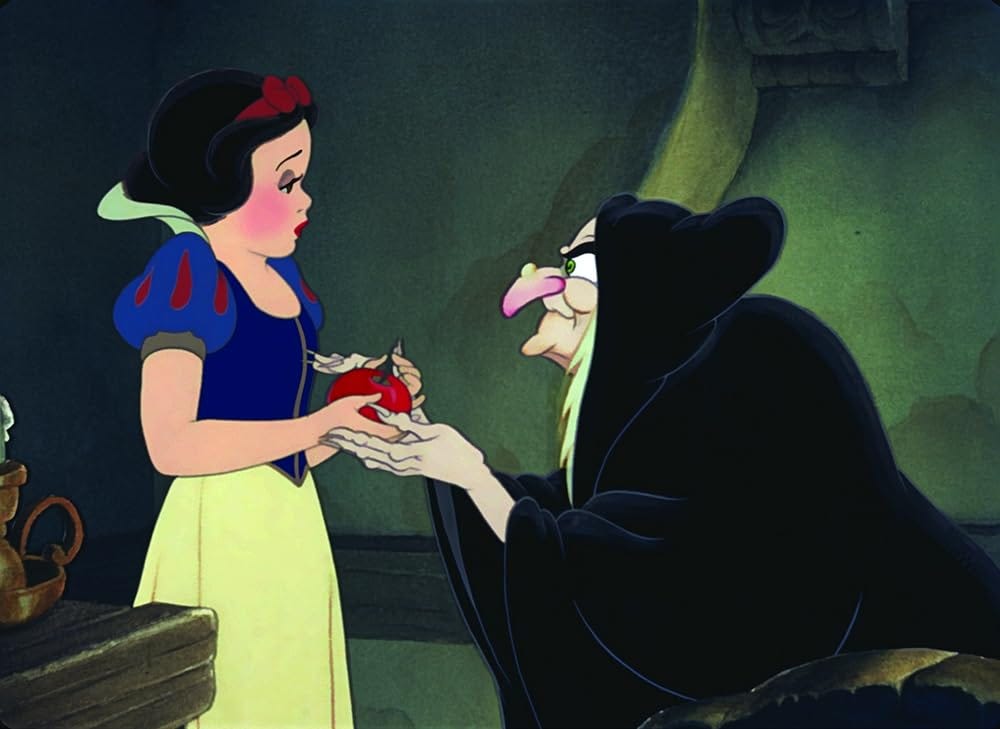
There’s a constant conversation – and quite rightly – about superficiality in Snow White and the Seven Dwarfs. Snow White falls for the prince in seconds, and vice versa, because they’re the prettiest people in the kingdom. The witch deserves her fate because she is ugly, and the dwarves can never really know love, other than the maternal affections bestowed by Snow White, because they are, well, dwarves.
But look a little deeper, and how the script by (credited to the writer’s room of Ted Sears, Richard Creedon, Otto Englander, Dick Rickard, Earl Hurd, Merrill De Maris, Dorothy Ann Blank and Webb Smith) handles the question of looks, youth, and beauty are a little more complex. Snow White herself constantly tries to see the good in everyone and is oblivious to her own beauty. The queen is beautiful but cannot stand for others to be so. In her quest to become the fairest, she transforms herself into ugliest she can possibly be. Walt’s lesson is not about beauty as an abstract goal but the corrupting nature of jealousy.
If anything, Snow White arguably establishes the greatest Disney trope – that the forces of evil are not vanquished by force but by their own hubris. Their well-earned demise often comes in a storm, often by falling from a great height (f there are autopsies in Disney animated films, “perilous plummet” is likely the most common cause of death). In later years, such self-inflicted fatal falls would take out the usurper Scar in The Lion King and Tarzan‘s great white hunter Clayton while The Hunchback of Notre Dame’s sanctimonious Frollo hurtled into the hellfire that he foresaw for everyone else. Yet the demise of the Queen is particularly exquisite in its vengeful comedy. Up on the mountain, she uses a branch as a pry bar to dislodge a boulder, so it will crush the dwarves and woodland creatures who pursue her. Instead, lightning strikes, and she plummets to her death. Just like the witch in Babes in Toyland, the evil queen is felled by her own malice.
And as she fell, audiences rose.
VIII: Happily Ever After?
It’s hard not to imagine that the success of Snow White, initially castigated as Walt’s Folly, was a validation to Walt. As big a role as he played in the film industry, there’s always a nagging feeling he saw himself as an outsider, and the greatest accolade may have come when the Academy gave him an honorary Oscar for his first feature. He already had six for his shorts, plus an honorary one for creating Mickey Mouse, but he was often basically competing against himself. Indeed, in the 11th Academy Awards, out of six nominees for Best Short Subject (Cartoon), only one - Paramount’s Hunky and Spunky, wasn’t a Disney release. But he was playing in the minor leagues. Even though Snow White didn’t snag a Best Feature nomination, Walt had proved that his silly project was a real movie.
It was also a very profitable movie, and the unprecedented commercial success was essential to allow Walt to do what he wanted. However, Walt could always spend more money than he could make, and it’s no secret that it was brother Roy who kept the lights on. With millions in the bank, he finally could build his own studio to his own specifications – and, of course, soon ended up $4.5 million in debt to the bank as he struggled to get his next animated project completed.
Delightful read, can’t wait for the next.
Fascinating. Looking forward to reading more of this series.